Build your MVP backend for free
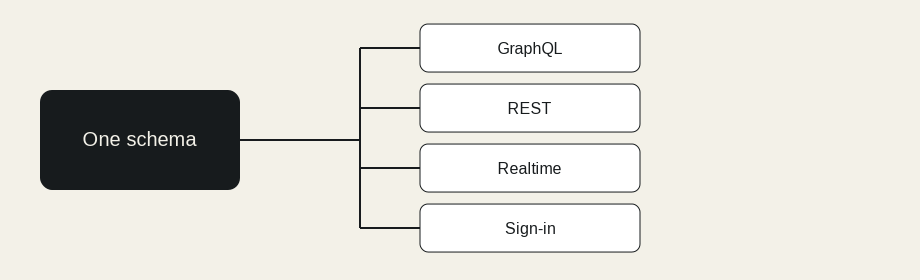
Apito gives your MVP sign-in, a GraphQL and REST API, realtime subscriptions and file storage, all from one schema. Free projects run on Apito Cloud SQLite (managed). You get 2 of them, with no card.
Open-source engine (AGPL-3.0). Questions: support@apito.io
Why founders switch backends after the MVP
Most hosted backends limit how many free projects you can run, and they pause the ones that go quiet. Supabase and Appwrite allow 2 free projects, and Nhost allows 1. All three pause a free project after a week without activity. On paid plans, Supabase charges compute for each extra project, from $10 a month.
That is fine for one app. It gets expensive for people who run a few small products at once, and that is most founders at the MVP stage.
“With 4 small tools running, I was looking at a projected $100/mo just to keep them alive.” r/Supabase, January 2026
“My Supabase Free project has been getting around 500 - 700 API requests daily … the project gets automatically paused.” r/Supabase, July 2026
“People love Supabase when they're building an MVP. But once the app starts getting real users, the conversations seem to change.” r/SaasDevelopers, July 2026
Apito's free tier is set up for running several small projects. Each one gets the full feature set, with the free-tier limits on the pricing page.
Limits from each vendor's pricing page, checked November 2026. Supabase, Appwrite, Nhost.
What every free project includes
- Sign-in. Email and password, plus Google, Facebook, GitHub, X and LinkedIn.
- GraphQL and REST APIs. Define your models and Apito serves both: GraphQL at api.apito.io/secured/graphql and REST at api.apito.io/secured/rest/<projectId>.
- Realtime. GraphQL subscriptions push changes to your app. You can filter by record id, a where clause or event type, and updates and deletes include the previous values. Today the Flutter SDK has typed realtime streams. There is no JavaScript or Go realtime SDK yet.
- Roles and permissions. Decide who can read and write each model.
- Plugins. EPS is the plugin that has shipped. You turn it on per project.
- DB explorer. Browse tables and run queries in the console.
- Schema versions. Changes are staged first. A person reviews and publishes them.
- CLI, Sync and MCP. Work from your terminal or let your editor's AI agent stage schema drafts. Agents can't publish.
Free Cloud has limits on storage, realtime and functions. Free-tier limits apply. See pricing for the numbers. Realtime install steps for Flutter are in the Flutter SDK docs.
How it works
- Create a project. Sign up at app.apito.io and pick Free Cloud. If you would rather start from data you already have, paste a JSON sample into the mock API tool or open a .db file in SQLite Builder.
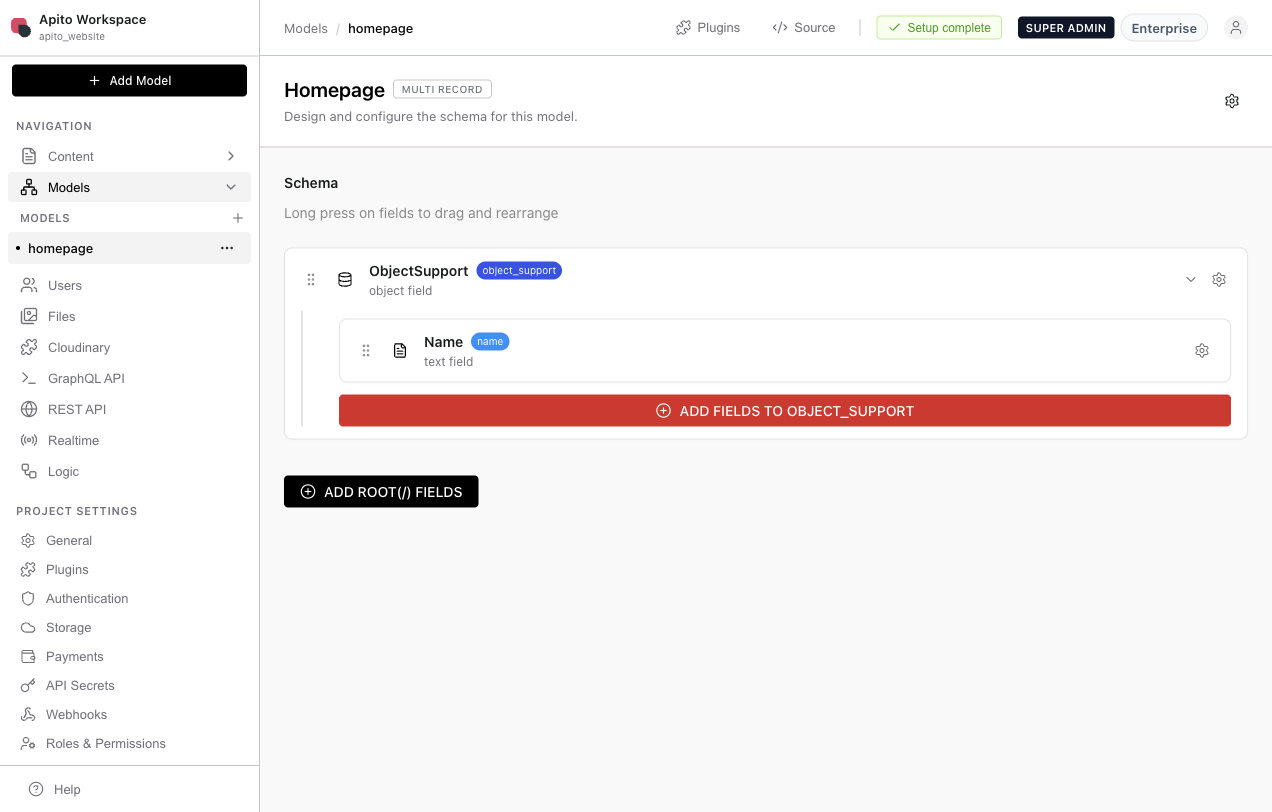
- Define your models. Add models and fields in the console, or from your editor through the MCP server.
- Call your API. Use GraphQL or REST from any client. Subscribe to changes from a Flutter app. Subscription syntax is in the Flutter SDK docs.
- Publish when ready. Review the staged schema changes and publish them.
How to build an MVP backend in a week
This stays useful even if you never sign up. Apito is a backend you use yourself, not a development shop.
- Write down the three to five things a user must do. Sign up, create the main record, see it change, pay. Everything else waits.
- Turn those into models. A to-do app needs User, List and Task. A marketplace needs User, Listing and Order. Keep fields minimal. You can add more later.
- Use ready-made sign-in. Password plus one social login covers most MVPs.
- Use the generated API instead of writing endpoints. Write custom code only for what is specific to your product.
- Add realtime only where users watch data change, such as chat, order status or a live dashboard.
- Take payments with the EPS plugin rather than building billing.
- Track one number, for example how many sign-ups make their first API call within a week.
How long it takes depends on your scope. When sign-in, APIs and storage come ready-made, the backend part is usually days rather than weeks, and most of the time goes into the screens and talking to users.
Why free projects run on SQLite
Free projects run on Apito Cloud SQLite (managed). SQLite stores each database in a single file, so an idle project costs disk space rather than a running database server. That is how Apito can offer 2 free projects.
SQLite works well for most MVPs. It handles many readers at once and one write at a time. If your app outgrows that, or you need Postgres or MongoDB, those run on a Dedicated instance.
Free tiers compared
| Apito Cloud Free | Supabase Free | Firebase Spark | Appwrite Free | Nhost Starter | |
|---|---|---|---|---|---|
| Free projects | 2 | 2 active | Quotas per project | 2 | 1 active |
| Database | SQLite (managed) | Postgres, 500 MB | Firestore, 1 GiB | 1 database per project | Postgres, 1 GB |
| APIs | GraphQL and REST | REST and GraphQL | SDKs, REST for some services | REST | GraphQL (Hasura) |
| Realtime | GraphQL subscriptions (Flutter SDK) | Yes | Yes | Yes | GraphQL subscriptions |
| First paid plan | Pro $25/month, 10 + 3 projects | Pro $25/month + $10 per extra project | Blaze, pay as you go | Pro $25/month, extra projects $15 | Pro $25/month |
Pricing and fair use
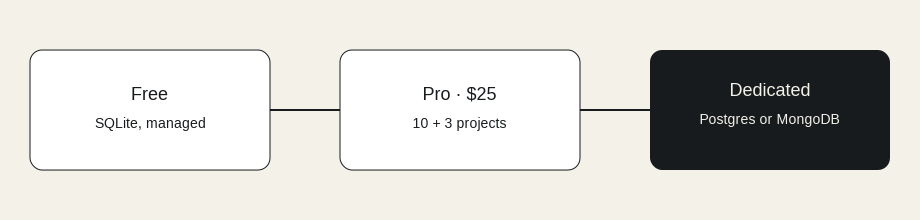
- Free, $0. 2 projects on Apito Cloud SQLite (managed). Every feature, with free-tier limits. See pricing for storage, requests and the other caps.
- Pro, $25 a month (billed through Paddle). 10 general projects and 3 shared-tenant SaaS projects, with higher limits.
- Dedicated, $45, $69 or $118 a month. Your own instance running Apito. It hosts many projects, up to 25, 50 or 100 depending on size. Postgres and MongoDB run on Dedicated instances. For now we set each instance up by hand within 24 hours.
- Self-host, free. The engine is open source. Run it on your own machine.
Full plan details · docs · Firebase alternative · Supabase alternative · open-source backend as a service
FAQ
What is the best backend for an MVP?
One that gives you sign-in, an API, a database and file storage without setup, lets you run a few projects for free, and has a clear paid path when one project takes off. Apito, Supabase, Firebase and Appwrite all cover the basics. They differ in free project limits, inactivity pausing and how paid plans charge for extra projects.
How long should it take to build an MVP?
It depends on scope. With sign-in, APIs and storage ready-made, the backend usually takes days. Most of the time goes into the screens and testing with users.
Is Apito free?
Yes. Free Cloud gives you 2 projects on Apito Cloud SQLite (managed), and you don't need a card. The engine is also open source, so you can run it yourself for free.
Why does the free tier use SQLite?
An idle SQLite project costs disk space, not a running database server, which is what lets Apito offer several free projects.
Is SQLite good enough for an MVP?
For most MVPs, yes. SQLite handles many readers at once and one write at a time. If you need Postgres or MongoDB, run your project on a Dedicated instance.
Can I move to Postgres later?
Postgres runs on Dedicated instances from $45 a month. There is no automatic SQLite-to-Postgres migration today.
Does Apito have realtime?
Yes, through GraphQL subscriptions. The Flutter SDK has typed realtime streams. There is no JavaScript or Go realtime SDK yet.
Do I need a credit card to start?
No.
Is Apito an MVP development agency?
No. Apito is a backend you use to build your own app. If you want someone to build the app for you, you are looking for an agency.
Start your MVP backend
2 free projects on Apito Cloud SQLite (managed). No card. Questions? Email support@apito.io or join the Discord.